
Volts vs Amps vs Watts vs Watt-Hours: How to Size a Portable Power Station
A practical guide for home-backup buyers, distributors and project teams comparing portable power stations.
Volts vs amps is one of the most common electrical comparisons, but choosing a portable power station requires four values—not two. Voltage (V) tells you the electrical pressure, current (A) tells you the rate of charge flow, watts (W) tell you how much power equipment is using now, and watt-hours (Wh) tell you how much energy a battery can deliver over time.
If you mix up watts and watt-hours, you can buy a unit that has enough output power but not enough runtime—or plenty of stored energy but an inverter that cannot start the intended appliance. The steps below show how to compare ratings, estimate runtime and select a practical 600W, 1000W, 2000W or 3000W class power station.
Quick answer: volts, amps, watts and watt-hours
| Term | Symbol | What it describes | Portable-power example |
|---|---|---|---|
| Voltage | V | Electrical potential or pressure | The AC output must match the appliance and destination market. |
| Current | A | Rate of electrical charge flow | A port, cable and connected device each have current limits. |
| Power | W | Instantaneous rate of energy use | A 1000W station can supply compatible loads within its continuous and surge limits. |
| Energy | Wh | Stored energy available over time | A 1000Wh battery can theoretically supply 100W for 10 hours before losses. |
| Battery charge | Ah / mAh | Charge capacity at a stated voltage | Ah cannot be compared fairly unless voltage is also known. |
The four equations buyers actually need
- Watts = Volts × Amps (W = V × A)
- Amps = Watts ÷ Volts (A = W ÷ V)
- Watt-hours = Watts × Hours (Wh = W × h)
- Battery energy = Volts × Amp-hours (Wh = V × Ah)
Example: a 12.8V, 70Ah battery stores 896Wh in nominal terms because 12.8 × 70 = 896. This is why battery voltage matters when comparing amp-hour figures. A 70Ah battery at 12.8V does not store the same energy as a 70Ah battery at 25.6V.
Volts vs amps: what is the difference?
Voltage is the potential that pushes charge through a circuit; amperage is the amount of current flowing. A simple water analogy is useful: voltage is similar to pressure, while amperage is similar to flow rate. The analogy is not a complete electrical model, but it explains why both values matter.
For a power-station buyer, the safest practical rule is to match the required AC voltage and frequency first, then confirm that every socket, port, cable and appliance remains within its rated current. A product intended for a 230V/50Hz market should not be assumed to match a 120V/60Hz appliance or plug system. Confirm voltage, frequency and socket standard before ordering.
Watts vs amps—and why voltage changes the answer
Watts describe power, while amps describe current. Because watts equal volts multiplied by amps, the same power can require different current at different voltages. A 1200W appliance draws about 10A at 120V but about 5.2A at 230V. Real products can also have power factor, startup demand and efficiency losses, so the equipment nameplate and manufacturer specifications remain the final reference.
Why watts and watt-hours are not interchangeable
Watts answer: Can the inverter operate the load right now? Watt-hours answer: How long can the battery support the load?
A 3000W / 2560Wh portable power station has a maximum continuous power class and a separate energy capacity. The first number must cover the connected equipment’s running demand and verified startup demand; the second is used to estimate operating time. Never treat a 3000W rating as if it means 3000Wh of storage.
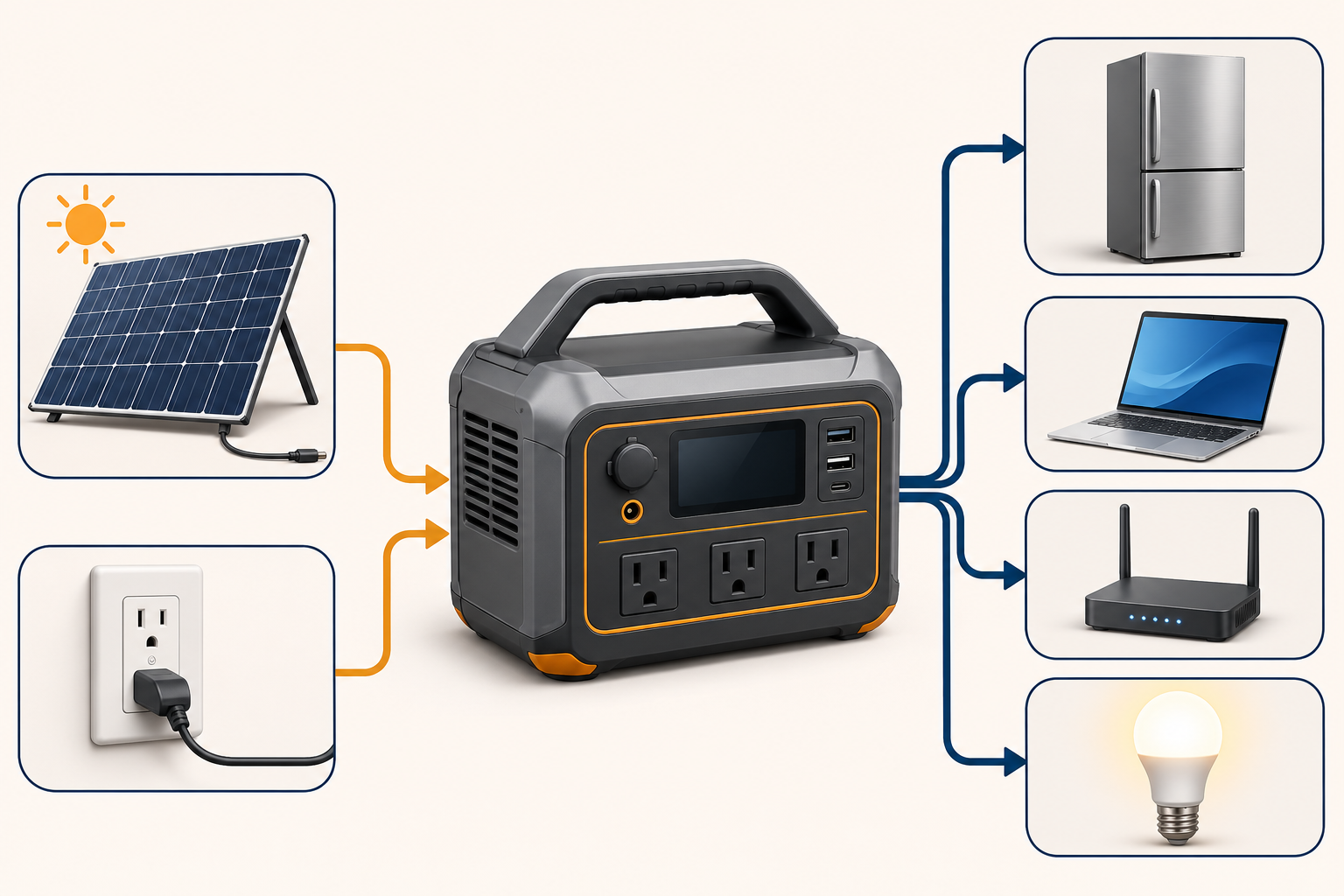
What is an amp-hour, and how do you convert mAh to watt-hours?
An amp-hour (Ah) is a charge-capacity rating. It becomes an energy rating only when paired with voltage. Use Wh = V × Ah. For milliamp-hours, divide by 1000 first: Wh = V × (mAh ÷ 1000).
For example, a 20,000mAh battery rated at 3.7V stores about 74Wh: 3.7 × (20,000 ÷ 1000) = 74. Do not convert mAh to Wh without the battery’s nominal voltage, and do not compare cell-level energy directly with an AC output estimate without allowing for conversion losses.
How to size a portable power station in five steps
- Make an appliance list: Record the rated voltage, running watts and—where relevant—starting or surge watts from each nameplate or manual. Do not rely on a generic online average when exact equipment data is available.
- Add simultaneous running watts: Count only the devices that may operate at the same time. This total must remain below the power station’s confirmed continuous AC output.
- Check starting watts vs running watts: Compressors, pumps and motors can draw much more power for a short period at startup. The verified surge limit must cover that event; a continuous rating alone is not enough.
- Estimate required watt-hours: Multiply the expected load by the desired runtime, then allow for inverter, battery-management and standby losses. A planning factor of 0.80–0.90 is common for early estimates; use the model-specific tested figure when available.
- Add sensible margin: Avoid designing a system that operates continuously at its limit. Extra output and energy margin helps accommodate load variation, battery ageing, temperature and future devices.
Runtime formula
Estimated runtime (hours) = battery capacity (Wh) × usable-energy factor ÷ connected load (W)
This is an estimate, not a guarantee. Actual runtime changes with load pattern, inverter efficiency, battery condition, ambient temperature, cable losses, power-management settings and whether a compressor or appliance cycles on and off.
Worked example 1: home-office essentials
| Load | Illustrative running power | Notes |
|---|---|---|
| Wi-Fi router | 15W | Confirm the adapter label. |
| Laptop and charger | 65W | Actual draw varies with charging and workload. |
| Three LED lamps | 30W | Example: 10W each. |
| Total | 110W | Simultaneous running load. |
Using a 896Wh battery and an 85% planning factor: 896 × 0.85 ÷ 110 ≈ 6.9 hours. The result is a planning estimate. Check actual device consumption and the selected model’s DC/AC behavior before committing to a runtime claim.
Worked example 2: refrigerator plus office backup
Assume a refrigerator rated at 150W while running, plus a 15W router, 65W laptop and 30W of lighting. The simultaneous running total is 260W. If the refrigerator requires 600W at startup, the power station must support at least that verified startup event as well as the 260W running load.
With a 2560Wh battery and an 85% planning factor, a conservative continuous-load estimate is 2560 × 0.85 ÷ 260 ≈ 8.4 hours. A refrigerator normally cycles, so real runtime may be different in either direction depending on ambient temperature, door openings, thermostat setting and compressor behavior.
Worked example 3: power tool or mobile worksite
A 1200W tool may have a much higher momentary startup demand. First verify the tool’s rated and startup requirements against the power station’s continuous and surge limits. If a compatible 3000W / 2560Wh station supplied a steady 1200W load, the same planning method gives about 1.8 hours: 2560 × 0.85 ÷ 1200. Intermittent tool use will produce a different result.
Which power class should you consider?
| Power class | Good starting point for | What to verify |
|---|---|---|
| 600–800W | Routers, laptops, lighting, charging and selected small appliances | Battery capacity, AC voltage, 50/60Hz, socket type and appliance startup demand |
| 1000–2000W | Multi-device backup, selected refrigerators, tools and mobile operations | Exact energy capacity, continuous/surge output and simultaneous loads |
| 3000W / 2560Wh | Higher-load backup, field work, shops and off-grid applications | Startup limit, AC configuration, charging inputs, ports, accessories and compliance documents |
Review Fortune Vast configurations: 600–800W MK Series | 1000–2000W MK Series | 3000W / 2560Wh station. Product compatibility depends on the confirmed configuration and the connected equipment.
Can a 1000W portable power station run a refrigerator?
Sometimes—but the label “1000W” is not enough to answer. Check the refrigerator’s running watts, compressor startup demand, voltage and frequency, then compare those values with the station’s continuous and surge ratings. Next, use the battery’s Wh rating to estimate runtime. Two 1000W stations can have very different battery capacities and therefore very different operating times.
How many watts does it take to run a house?
There is no single number. A whole house may contain heating, cooling, water heating, cooking equipment, pumps and other high-demand loads. Start with an essential-load plan instead: refrigeration, communications, lighting, medical or security equipment and selected outlets. A portable power station is usually sized for defined critical loads, not assumed to power every circuit in a building.
Do not connect a portable power source to building wiring unless the equipment and transfer method are specifically designed for that purpose and installed according to local requirements. Follow the manufacturer’s instructions and use a qualified electrician where fixed wiring is involved.
Eight questions to ask before buying or sourcing
- What are the exact continuous and surge output ratings?
- What is the usable battery capacity in Wh, not only the Ah figure?
- Which AC voltage, frequency and socket standard will be supplied?
- Which battery chemistry and battery-management protections are used?
- What AC, solar and vehicle charging inputs are supported, and at what limits?
- Which AC, USB, Type-C and DC ports are included in the quoted configuration?
- Which accessories, cables, chargers and solar panels are included in the package?
- Which model-specific compliance and transport documents are available for the destination market?
B2B and wholesale buyers: specify the market, not just the wattage
Distributors and project buyers should send a short configuration brief with the inquiry. Include destination country, required AC voltage and frequency, socket standard, target loads, expected runtime, battery chemistry, charging method, output ports, branding, packaging, certification needs, order quantity and delivery location.
This prevents a common sourcing mistake: comparing two quotations that use the same headline wattage but different battery capacity, port layout, charger, socket type or package contents. Ask for a model-specific specification sheet and final package list before payment.
For current model ranges and factory-direct pricing, review the Fortune Vast wholesale catalog. For a deeper capacity comparison, see the LiFePO4 portable power station runtime guide.
Common mistakes to avoid
- Choosing by watts alone and ignoring watt-hours.
- Comparing amp-hours without comparing battery voltage.
- Using average internet appliance figures instead of the actual nameplate.
- Ignoring compressor, motor or pump startup demand.
- Assuming all 1000W or 2000W models have the same ports, battery or charger.
- Assuming listed capacity equals usable AC energy with no conversion loss.
- Ordering the wrong AC voltage, frequency or socket for the destination market.
- Treating a runtime calculation as a guaranteed operating time.
Frequently asked questions
Is an amp the same as a watt?
No. An amp measures current; a watt measures power. The relationship is W = V × A for a simple DC or resistive calculation.
What is the difference between volts and watts?
Volts describe electrical potential; watts describe the rate of energy use. Watts depend on voltage and current.
What does amp-hour mean on a battery?
Amp-hour measures charge capacity at a stated voltage. Multiply volts by amp-hours to estimate nominal watt-hours.
How do I convert mAh to watt-hours?
Divide mAh by 1000 to get Ah, then multiply by nominal voltage: Wh = V × (mAh ÷ 1000).
What is the difference between starting watts and running watts?
Running watts are the power used during normal operation. Starting or surge watts are the short higher demand when a motor, compressor or pump starts.
Is a 1000Wh power station the same as a 1000W power station?
No. 1000Wh is energy capacity; 1000W is output power. A unit may have one rating without matching the other.
Should I choose a larger power station than my calculation?
A reasonable margin is useful for load variation, efficiency losses, ageing and future devices, but the correct margin depends on the equipment and application.
Get a configuration matched to your equipment
Send Fortune Vast your appliance list, running and startup watts, required runtime, destination voltage, frequency, socket type, order quantity and shipping destination. The team can confirm a suitable configuration and prepare a model-specific quotation for sample evaluation, wholesale distribution or project procurement.
Request a model-specific quotation