
Quick Answer (BLUF): Choosing the best generator for a home power outage depends on your household’s essential continuous wattage and starting surge loads. While a noisy gas generator requires outdoor placement and ongoing fuel storage, an indoor-safe 2,000W / 2,000Wh LiFePO4 solar generator keeps full-size kitchen refrigerators, Wi-Fi routers, medical CPAP units, and gas furnace blowers running seamlessly with zero emissions and sub-20ms EPS/UPS auto-switchover.
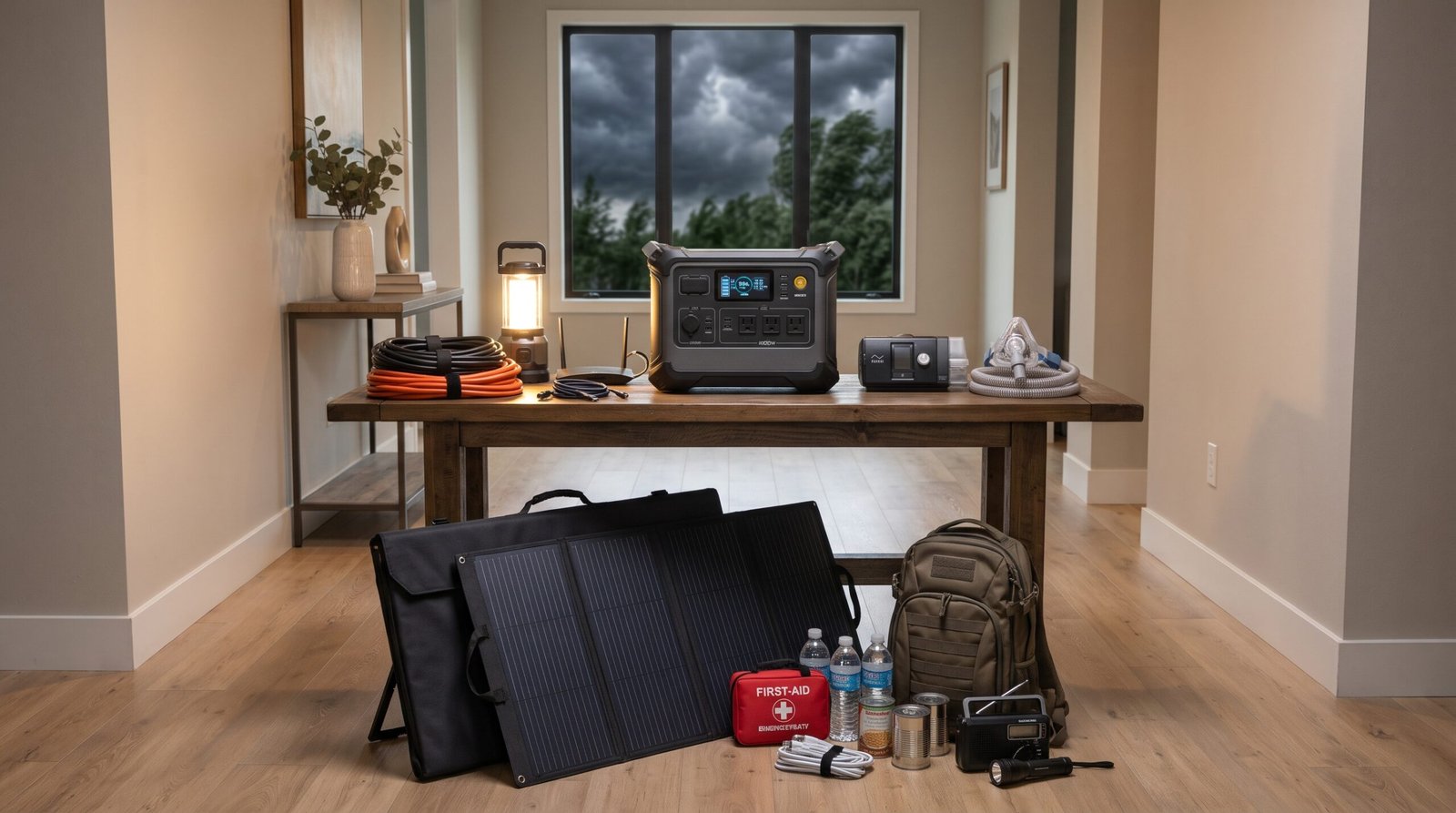
1. Home Blackout Load Audit: Essential vs. Luxury Appliances
When the grid goes down during severe storms or winter freezes, the biggest mistake homeowners make is attempting to power the entire 200-amp service panel. The smart survival strategy is isolating your critical life-safety, food preservation, and communications circuits:
| Essential Household Appliance | Running Watts | Starting Surge | Recommended Backup Tier |
|---|---|---|---|
| Wi-Fi Router + Fiber ONT Modem + Laptops | 40W – 85W | None (85W) | 500Wh – 1,000Wh Station (18–36 hrs) |
| Medical CPAP Machine (12V DC Mode) | 15W – 45W | None (45W) | 500Wh – 1,000Wh Station (2–4 nights) |
| Full-Size Kitchen Refrigerator (18–25 cu ft) | 120W – 220W | 800W – 1,500W | 1,500Wh – 2,000Wh Station (14–20 hrs) |
| Gas Furnace Blower Fan (Winter Heat) | 350W – 600W | 1,000W – 1,400W | 2,000W+ High-Output Unit |
| Basement Sump Pump (1/3 to 1/2 HP) | 600W – 850W | 1,800W – 2,500W | 2,000W+ (4,000W Surge Rating) |
| LED Room Lamps (x4) + Phone Charging (x3) | 35W – 60W | None (60W) | Any 500Wh+ Portable Unit |
2. Power Station Sizing: How Much Capacity (Wh) Do You Really Need?
Battery stations are rated by two numbers: Continuous Wattage (W) (the inverter’s ability to drive heavy appliances like microwaves or refrigerators) and Capacity (Watt-hours or Wh) (the size of the fuel tank). Calculate your expected duration using the industry standard 85% inverter conversion formula:
Actual Working Hours = Battery Capacity (Wh) × 0.85 (Inverter Efficiency) ÷ Total Connected Load (Watts)
Tip: For cycling loads like your refrigerator compressor, read our complete sizing breakdown on How Many Watts to Run a Refrigerator.
Tier 1: 500Wh – 1,000Wh
Best For: Apartment dwellers, remote workers, and CPAP medical users needing 24–48 hours of phone recharges, router uptime, LED lighting, and laptops.
Tier 2: 1,500Wh – 2,000Wh+
Best For: Suburban homes facing multi-day blizzards or summer grid collapses. Powers refrigerators, sump pumps, coffee makers, and medical gear simultaneously.
3. Gas Generator vs. Solar Battery Station: Why Indoor Safety Wins
While an open-frame gas generator delivers cheap raw watts, it is strictly forbidden indoors due to lethal carbon monoxide (CO) fumes. As detailed in our Inverter Generator vs. Portable Power Station Guide, modern LiFePO4 battery backups deliver unmatched convenience:
- 100% Indoor & Apartment Safe: Zero carbon monoxide, zero noxious fumes, and zero flammable gasoline cans stored in your garage.
- Sub-20ms EPS / UPS Auto-Switchover: Keeps your Wi-Fi, CPAP, and desktop computer running continuously the exact second the power cuts out.
- Whisper-Quiet Operation: Runs under 30 dB—ideal for night-time operation without waking children or violating noise ordinances.
- Long-Life LiFePO4 Chemistry: 3,500+ full charge cycles to 80% capacity (10+ years of regular emergency readiness).
4. The 72-Hour Power Cut Survival Kit: 6 Critical Items
Don’t wait for hurricane or winter storm warnings to empty store shelves. Prepare this proven 72-hour power cut checklist:
- Primary 2,000Wh LiFePO4 Power Station: Serves as the central electricity hub for your kitchen refrigerator and home communications.
- 200W to 400W Foldable Solar Panels: Provides daytime solar replenishment, harvesting 800Wh to 1,600Wh of free energy every sunny afternoon.
- 12V DC Heated Blankets: Stay warm during winter freezes (read our Space Heater Wattage & Camping Guide) without depleting AC inverter battery capacity.
- Heavy-Duty 12 AWG Extension Cord: Prevents voltage drops when running power from hallway stations to kitchen appliances.
- Emergency Weather Radio & LED Lanterns: Keeps you updated on utility repair timelines and local civil defense alerts.
- Sealed Water Storage (1 gal/person/day): Essential if your home relies on an electric well pump.
Defend Your Home Before the Next Blackout
Protect your family, expensive food supply, and life-critical medical equipment against unpredictable grid collapses. Fortune Vast 2,000W / 1,920Wh LiFePO4 Emergency Power Stations feature 4,000W peak surge handling, rapid AC/Solar dual charging, and 20ms EPS continuous backup.
5. Frequently Asked Questions (FAQ)
Can a 2,000W power station run a whole-house central air conditioner?
No. Central HVAC units require 240V split-phase power and 3,500W to 6,000W of running power. However, a 2,000W unit easily runs a 5,000–8,000 BTU window A/C unit or rooftop RV air conditioner (see our 30 Amp vs. 50 Amp RV Generator Guide).
How long does food stay cold in a refrigerator during a blackout?
An unopened refrigerator keeps food safely cold for approximately 4 hours without power. A full deep-chest freezer maintains safe temperatures for 48 hours. By plugging your fridge into a 2,000Wh battery station, you extend preservation indefinitely when paired with daytime solar panels.