
How to prepare essential supplies, calculate critical electrical loads and choose backup power for a home or small business.
A reliable power outage survival kit is more than a flashlight and a phone charger. It should protect people first, keep communication available, support essential electrical loads and provide a safe backup-power plan for the expected outage duration.
The right kit depends on local weather, household size, medical needs, building type and the equipment that must keep running. A short urban outage may require only lights, a router and phone charging. A multi-day outage may require refrigeration, medical equipment, water pumping or a larger solar-rechargeable power system.
Quick power outage survival kit checklist
| Category | Recommended items | Why they matter |
|---|---|---|
| Light and safety | LED flashlights, headlamps, spare batteries, first-aid kit and fire extinguisher | Reduces falls and avoids the fire risk associated with candles |
| Communication | Charged phones, power banks, battery radio and printed contact list | Maintains alerts and family communication |
| Food and water | Stored water, shelf-stable food, manual can opener and hygiene supplies | Supports basic needs without electric cooking |
| Essential electricity | Portable power station, charging cables, extension lead and compatible solar panels | Keeps selected low- and medium-power devices operating |
| Documents and cash | Identification copies, insurance information, prescriptions and cash | Useful when online systems or payment terminals are unavailable |
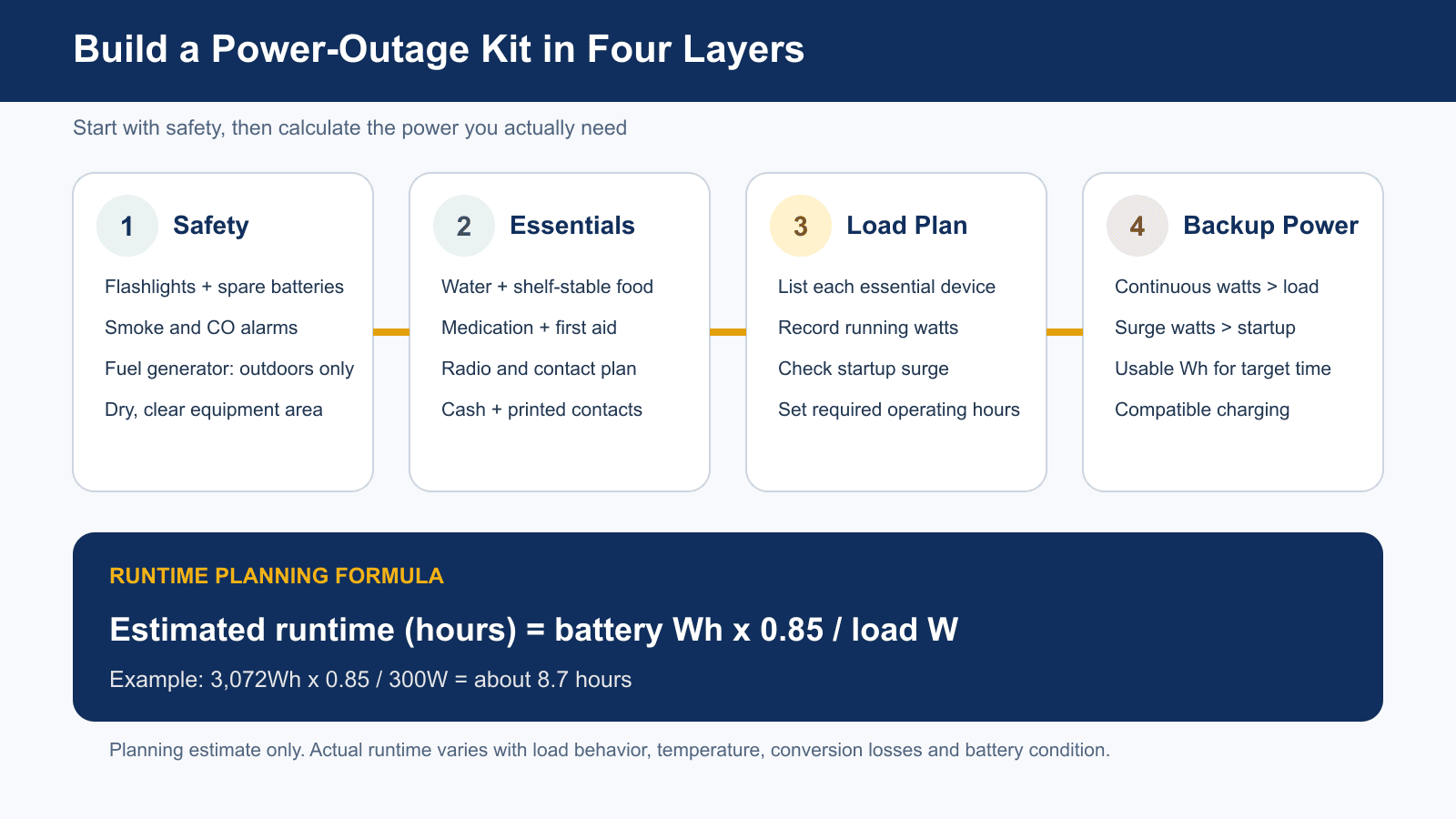
Layer 1: protect people before powering appliances
Start with non-electrical essentials. Place a flashlight or headlamp in every frequently used area and make sure everyone knows where it is. LED lighting is safer and more efficient than candles.
Keep a first-aid kit, required medication and a clearly labelled emergency contact list in an accessible location. Store drinking water and shelf-stable food based on local emergency guidance and household needs.
If a family member relies on electrically powered medical equipment, develop a backup plan with the equipment provider and local emergency services before an outage occurs.
Layer 2: maintain communication and information
Mobile networks and home internet may continue operating during a short outage, but household routers still require electricity. Include phone charging cables, power banks and a battery or hand-crank radio.
A low-power router and optical network terminal may be worth supporting if the external network remains active. Download important documents, maps and contact information for offline use.
Keep a paper list of emergency numbers because a discharged or damaged phone should not be your only source of information.
Layer 3: identify essential electrical loads
Trying to power an entire home usually makes an emergency system expensive and inefficient. Divide appliances into three groups:
- Critical: medical equipment, communication, essential lighting and safety systems.
- Important: refrigerator, selected fans, laptop, security equipment and small water pumps.
- Optional: electric heating, large air conditioners, electric ovens and water heaters.
Build the first version of the kit around critical loads. Add important loads only after confirming both battery capacity and inverter power.
How to calculate backup battery capacity
Energy consumption is calculated in watt-hours:
Energy required (Wh) = appliance power (W) × operating time (hours)
Add the watt-hours for every device, then allow for inverter losses, standby consumption and an emergency reserve.
Recommended battery capacity = total load energy ÷ system efficiency + reserve
If the planned loads require 800Wh and estimated system efficiency is 85%, the calculation is:
800Wh ÷ 0.85 = 941Wh
Adding a 20% emergency reserve produces a requirement of approximately 1,130Wh. A nominal 1,000Wh station may be marginal, so the next suitable capacity may be more practical.
| Example load | Power | Planned use | Energy |
|---|---|---|---|
| Internet router and terminal | 15W | 12 hours | 180Wh |
| LED lighting | 20W | 6 hours | 120Wh |
| Laptop | 60W | 3 hours | 180Wh |
| Essential medical or monitoring device | 40W | 8 hours | 320Wh |
| Total before losses | — | — | 800Wh |
Actual power varies by product model and operating condition. Measure important loads with a power meter where possible and use appliance labels only as an initial estimate.
Do not confuse watt-hours and watts
Watt-hours describe stored energy and help estimate runtime. Watts describe instantaneous power and determine whether the inverter can operate an appliance.
A power station may contain enough stored energy to run a refrigerator but still fail to start its compressor if the inverter surge rating is too low.
Check continuous power, surge power and the startup behaviour of motor loads. For critical equipment, test the exact appliance and power station together before relying on the system during an emergency.
Portable power station or fuel generator?
A portable battery power station is quiet, produces no exhaust during normal operation and can generally be operated indoors according to the manufacturer’s instructions. It is suitable for electronics, lighting, communication devices, medical equipment and moderate household loads.
A fuel generator can provide higher sustained output and continue operating while fuel is available. However, it creates carbon monoxide and must never be operated inside a home, garage, basement, shed or other enclosed or partially enclosed space.
Fuel generators also require safe fuel storage, maintenance and correctly routed outdoor extension cables.
Some households use a layered approach: a battery station handles indoor and overnight loads, while an outdoor generator supports higher-power equipment or recharges the battery station when conditions permit.
How to choose a portable power station for outages
- Battery capacity: enough watt-hours for the planned runtime and emergency reserve.
- Continuous output: greater than the combined running power of connected loads.
- Surge rating: suitable for refrigerators, pumps and motor-driven equipment.
- Battery chemistry: LiFePO4 is widely used for long-cycle portable systems.
- Charging speed: grid and solar input should restore useful capacity within the available time.
- Solar compatibility: panel voltage and current must remain within MPPT limits.
- Output waveform: pure sine wave AC is preferred for sensitive equipment.
- Regional configuration: correct voltage, frequency and socket standard.
- Documentation: model-specific safety, transport and compliance records.
For a larger commercial example, review the 4608Wh LiFePO4 portable power station runtime guide.
Refrigerator and freezer planning
Refrigerators do not usually consume their rated power continuously. The compressor cycles on and off, but its startup power can be several times higher than its normal running power.
Temperature, insulation, door opening and food load all affect energy consumption. Use a plug-in meter to measure a full 24-hour period under normal conditions.
Confirm that the power station can support compressor startup and avoid opening the refrigerator unnecessarily during an outage.
Solar charging during a long outage
Solar panels can extend battery runtime, but their nameplate power is not the same as the energy delivered throughout the day.
Weather, orientation, shading, temperature, cable losses and MPPT limits reduce actual output. A 400W panel array will not continuously produce 400W.
Size the array according to the average daily energy that needs to be replaced. Confirm the power station’s permitted solar-input voltage and current ranges.
Panels connected in series can exceed the power station’s voltage limit even when total wattage appears acceptable. Request a matched panel configuration if you are unsure.
Maintenance and readiness schedule
- Monthly: check flashlights, radios, cables, medicine dates and emergency contacts.
- Every three months: inspect and recharge the portable power station according to its manual.
- Before severe weather: fully charge batteries and test important appliances.
- Annually: replace expired supplies and repeat the household load calculation.
Store the power station in a dry, ventilated location within the manufacturer’s specified temperature range. Do not cover ventilation openings or use damaged charging cables.
Frequently asked questions
What should be included in a power cut survival kit?
Include lighting, first aid, medication, water, shelf-stable food, hygiene supplies, communication tools, charging cables, important documents and a backup-power source sized for critical electrical loads.
What size power station is needed for a home outage?
Add the watt-hours required by essential devices, account for conversion losses and include a reserve. Separately confirm that the inverter’s continuous and surge ratings can start and operate the intended appliances.
Can a portable power station run a refrigerator?
Yes, provided its continuous output, surge rating and usable capacity match the refrigerator. Measure actual 24-hour energy consumption and test compressor startup before an emergency.
Can a portable power station be used indoors?
Battery power stations do not burn fuel during normal operation and are designed for indoor use when operated according to their manuals. Keep ventilation openings clear and follow all charging instructions.
Can a gasoline generator be used in a garage with the door open?
No. Carbon monoxide can accumulate and enter the building. Fuel generators must be operated outdoors, well away from doors, windows and ventilation openings.
What is the best generator for a home power outage?
The best system is one correctly sized for the required loads and operated safely. Battery stations suit quiet indoor essential loads, while fuel generators can provide higher continuous power but require strict outdoor operation and maintenance.