
A practical comparison for portable-power buyers, distributors and energy-storage project teams.
Sodium-ion vs LiFePO4 batteries is becoming an important comparison for buyers evaluating the next generation of portable power stations. Both chemistries avoid nickel and cobalt and can be designed for stationary energy storage, but they are not interchangeable.
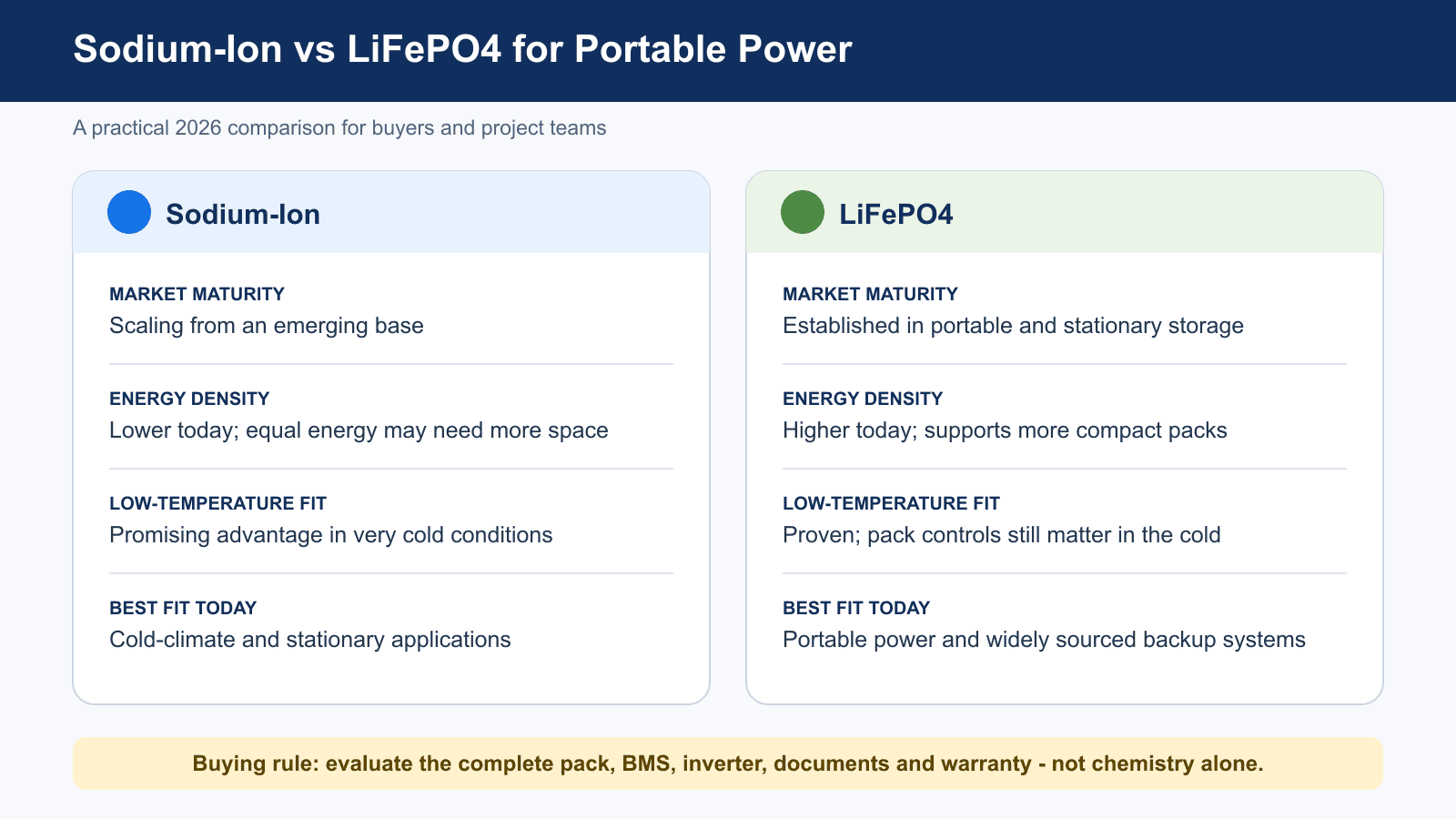
LiFePO4, or lithium iron phosphate, is already widely used in commercial portable power stations because it offers a proven balance of cycle life, safety, energy density and manufacturing scale. Sodium-ion technology is progressing quickly and may become attractive where raw-material availability, cold-weather performance and supply-chain diversification matter more than minimum weight and size.
Quick answer: which chemistry is better?
For most portable power stations available today, LiFePO4 remains the more established choice. It offers higher practical energy density, a mature supplier base, long cycle life and extensive field experience.
Sodium-ion is promising for cost-sensitive stationary systems, cold environments and markets seeking less dependence on lithium supply chains, but its commercial ecosystem is still developing.
| Comparison point | Sodium-ion | LiFePO4 |
|---|---|---|
| Commercial maturity | Emerging and scaling | Established and widely available |
| Energy density | Generally lower | Generally higher |
| Product size | Usually larger for equal usable energy | More compact for equal usable energy |
| Raw materials | Abundant and geographically diverse sodium | Established lithium, iron and phosphate supply chains |
| Cold-weather potential | Potentially strong, depending on cell design | Charging below freezing requires careful control |
| Best current fit | Stationary storage and supply diversification | Portable stations, solar backup and mobile power |
What is a sodium-ion battery?
A sodium-ion battery stores and releases energy by moving sodium ions between its positive and negative electrodes. The operating principle resembles a lithium-ion battery, but the active materials, electrolyte, voltage range and manufacturing details are different.
Sodium is widely available and can be sourced from abundant materials. Some sodium-ion designs can also use aluminium current collectors on both sides. These advantages do not automatically make every sodium battery cheaper. Cell yield, production volume, cathode choice, pack design and certification costs all affect the finished product price.
Sodium-ion manufacturing capacity is expanding, but the technology still faces challenges involving energy density, commercial scale and supply-chain maturity. Buyers should therefore evaluate actual cell and battery-pack data instead of treating all sodium-ion products as identical.
What is a LiFePO4 battery?
LiFePO4 is a lithium-ion chemistry that uses lithium iron phosphate as the cathode material. It has become common in portable power stations, solar storage and electric mobility because it combines long service life with relatively stable thermal behaviour.
A properly engineered LiFePO4 power station includes more than battery cells. Its battery-management system monitors voltage, current and temperature. The inverter converts DC energy into usable AC power, while the charger or MPPT controller manages grid and solar input.
Cell quality, pack matching, busbar design, thermal management and firmware can affect real-world performance as much as the battery chemistry name.
Energy density and product size
Sodium-ion cells generally store less energy per kilogram than commercial LiFePO4 cells. A sodium-ion power station may therefore require a larger or heavier battery pack to provide the same watt-hour capacity.
This difference matters for camping, service vehicles, mobile workshops and emergency-response teams, where equipment must be moved frequently. In a fixed home-backup cabinet or telecom installation, additional volume may be acceptable.
Do not compare products by nominal capacity alone. Ask for net weight, external dimensions, rated watt-hours and usable discharge energy under clearly stated test conditions.
Cycle life and expected service life
Cycle life is the number of charge-discharge cycles a battery can complete before its measured capacity falls to a defined threshold.
A claim such as “4,000 cycles” is incomplete unless it also specifies:
- Depth of discharge
- Charge and discharge current
- Operating temperature
- End-of-life capacity threshold
Commercial LiFePO4 cells can provide long cycle life when used within their specified temperature and voltage limits. Sodium-ion cells may also deliver strong cycle performance, but results vary across cathode and anode formulations.
Wholesale buyers should request the exact cell model, test method and capacity-retention curve instead of relying on a chemistry-level marketing claim.
Safety and thermal stability
Both sodium-ion and LiFePO4 are commonly described as thermally stable battery options, but no rechargeable battery is completely risk-free.
Battery-pack safety depends on cell consistency, electrical protection, enclosure construction, ventilation, isolation spacing and the battery-management system.
For a finished portable power station, verify protection against:
- Overcharging
- Over-discharging
- Overcurrent
- Short circuits
- Excessively high or low temperatures
Confirm that the supplied reports cover the exact cell and product configuration. A report for another cell capacity or battery-pack model should not automatically be treated as evidence for the product being purchased.
Buyers can review Fortune Vast’s model-specific certification and quality-control information and request documents applicable to the selected configuration and destination market.
Cold-weather performance
Sodium-ion batteries are attracting attention for low-temperature performance. Some cell designs retain useful discharge capability at temperatures where conventional lithium-ion systems lose power.
However, “works at low temperature” must be separated into three different specifications:
- Permitted discharge temperature
- Permitted charging temperature
- Permitted storage temperature
Charging is normally the more sensitive condition. A battery may discharge below freezing while restricting charge current until its cells become warmer.
Ask the supplier for the permitted temperature ranges, automatic heating behaviour and power-derating curve. LiFePO4 systems can also operate reliably in cold climates when the BMS, heater and enclosure are designed for the intended environment.
Cost and supply-chain considerations
Sodium-ion technology could reduce exposure to lithium pricing and broaden the geographic availability of battery raw materials. It may eventually compete strongly in stationary applications where size and weight have lower priority.
LiFePO4 currently benefits from larger manufacturing volumes, experienced battery-pack suppliers, established components and a mature testing ecosystem.
A new chemistry may use inexpensive raw materials while still carrying higher product-development, validation or minimum-order costs. Buyers should compare total system cost rather than raw-material prices alone.
How chemistry affects a portable power station
The battery chemistry influences capacity, weight and operating temperature, but a useful portable station must also match the intended electrical loads.
Check these specifications together:
- Rated inverter power: the continuous AC output the unit can sustain.
- Surge power: short-duration capability for motors, compressors and pumps.
- Usable battery energy: energy available after conversion losses and protection limits.
- AC waveform: pure sine wave is preferred for sensitive electronics and motor loads.
- Solar input: MPPT voltage range, current limit and maximum charging power.
- Regional output: correct voltage, frequency and socket type.
- Serviceability: replaceable components, error diagnostics and warranty support.
For a practical capacity and load example, read the 4608Wh LiFePO4 portable power station runtime guide.
Wholesale buyer checklist
- Confirm the cell manufacturer, exact model, chemistry and rated capacity.
- Request the battery-pack voltage, usable watt-hours and permitted depth of discharge.
- Check the conditions used for cycle-life testing.
- Review charge, discharge and storage temperature ranges.
- Match the inverter power and surge rating to the intended appliances.
- Confirm the AC voltage, frequency, socket type and solar-input range.
- Request documents for the exact model and destination market.
- Define full-load testing and pre-shipment inspection requirements.
- Confirm warranty terms, replacement parts and after-sales responsibilities.
- Validate packaging and transport requirements before mass production.
Which chemistry should buyers choose?
Choose LiFePO4 when you need an established portable-power platform, competitive energy density, long cycle life and a mature supply chain. It is currently the practical default for most wholesale portable power stations and mobile backup systems.
Evaluate sodium-ion when cold-weather behaviour, supply-chain diversification or stationary installed cost is a priority and you can validate the exact cell and battery pack.
The final decision should be based on the complete system and its verified test data—not on battery chemistry alone.
Frequently asked questions
Is sodium-ion safer than LiFePO4?
Both chemistries can be engineered for strong thermal stability. Safety depends on the cell design, battery-management system, pack construction, protection settings and test evidence.
Will sodium-ion replace LiFePO4?
Complete replacement is unlikely in the near term. Sodium-ion may gain market share in stationary storage and cold-climate applications, while LiFePO4 remains highly competitive for portable power and solar storage.
Which battery is better for a portable power station?
LiFePO4 is currently the more established option because it offers a strong balance of energy density, cycle life, availability and manufacturing experience.
Does a higher cycle-life number always mean a better battery?
No. Cycle-life results are only comparable when depth of discharge, temperature, current rate and end-of-life capacity are clearly defined.
Can Fortune Vast customize a portable power station?
Customization options can include AC voltage and frequency, regional sockets, branding, packaging, solar-input requirements and accessories. Review the OEM and ODM customization process or contact the Fortune Vast team.